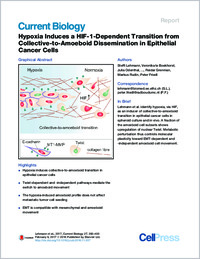
Hypoxia Induces a HIF-1-Dependent Transition from Collective-to-Amoeboid Dissemination in Epithelial Cancer Cells.
- Lehmann S Department of Cell Biology, Radboud University Medical Center, 6525 GA Nijmegen, the Netherlands; Institute for Biomedical Engineering, ETH and University of Zurich, 8093 Zurich, Switzerland. Electronic address: lehmann@biomed.ee.ethz.ch.
- Te Boekhorst V Department of Cell Biology, Radboud University Medical Center, 6525 GA Nijmegen, the Netherlands; Department of Genitourinary Medical Oncology, The University of Texas MD Anderson Cancer Center, Houston, TX 77030, USA.
- Odenthal J Department of Cell Biology, Radboud University Medical Center, 6525 GA Nijmegen, the Netherlands; Department of Otolaryngology and Head and Neck Surgery, Radboud University Medical Center, 6525 EX Nijmegen, the Netherlands.
- Bianchi R Institute for Biomedical Engineering, ETH and University of Zurich, 8093 Zurich, Switzerland; Institute for Pharmaceutical Sciences, ETH Zurich, 8093 Zurich, Switzerland.
- van Helvert S Department of Cell Biology, Radboud University Medical Center, 6525 GA Nijmegen, the Netherlands.
- Ikenberg K Institute for Pharmaceutical Sciences, ETH Zurich, 8093 Zurich, Switzerland; Institute of Pathology and Molecular Pathology, University Hospital Zurich, 8091 Zurich, Switzerland.
- Ilina O Department of Cell Biology, Radboud University Medical Center, 6525 GA Nijmegen, the Netherlands.
- Stoma S Scientific Center for Optical and Electron Microscopy (ScopeM), ETH Zurich, 8093 Zurich, Switzerland.
- Xandry J Institute for Biomedical Engineering, ETH and University of Zurich, 8093 Zurich, Switzerland.
- Jiang L Department of Genitourinary Medical Oncology, The University of Texas MD Anderson Cancer Center, Houston, TX 77030, USA.
- Grenman R Department of Otorhinolaryngology-Head and Neck Surgery, Turku University and Turku University Hospital, 20521 Turku, Finland.
- Rudin M Institute for Biomedical Engineering, ETH and University of Zurich, 8093 Zurich, Switzerland; Institute of Pharmacology and Toxicology, University of Zurich, 8057 Zurich, Switzerland.
- Friedl P Department of Cell Biology, Radboud University Medical Center, 6525 GA Nijmegen, the Netherlands; Department of Genitourinary Medical Oncology, The University of Texas MD Anderson Cancer Center, Houston, TX 77030, USA; Cancer Genomics Center, 3584 CG Utrecht, the Netherlands. Electronic address: peter.friedl@radboudumc.nl.
- 2017-01-17
Published in:
- Current biology : CB. - 2017
amoeboid cell migration
cancer invasion
collective-to-amoeboid transition
epithelial-to-mesenchymal transition
hypoxia
hypoxia-inducible factors
plasticity of cell migration
Breast Neoplasms
Cell Adhesion
Cell Line, Tumor
Cell Movement
Epithelial-Mesenchymal Transition
Female
Head and Neck Neoplasms
Humans
Hypoxia-Inducible Factor 1
Mechanotransduction, Cellular
Neoplasm Metastasis
Nuclear Proteins
Tumor Hypoxia
Twist-Related Protein 1
English
Cancer metastases arise from a multi-step process that requires metastasizing tumor cells to adapt to signaling input from varying tissue environments [1]. As an early metastatic event, cancer cell dissemination occurs through different migration programs, including multicellular, collective, and single-cell mesenchymal or amoeboid migration [2-4]. Migration modes can interconvert based on changes in cell adhesion, cytoskeletal mechanotransduction [5], and/or proteolysis [6], most likely under the control of transcriptional programs such as the epithelial-to-mesenchymal transition (EMT) [7, 8]. However, how plasticity of tumor cell migration and EMT is spatiotemporally controlled and connected upon challenge by the tumor microenvironment remains unclear. Using 3D cultures of collectively invading breast and head and neck cancer spheroids, here we identify hypoxia, a hallmark of solid tumors [9], as an inducer of the collective-to-amoeboid transition (CAT), promoting the dissemination of amoeboid-moving single cells from collective invasion strands. Hypoxia-induced amoeboid detachment was driven by hypoxia-inducible factor 1 (HIF-1), followed the downregulation of E-cadherin, and produced heterogeneous cell subsets whose phenotype and migration were dependent (∼30%) or independent (∼70%) of Twist-mediated EMT. EMT-like and EMT-independent amoeboid cell subsets showed stable amoeboid movement over hours as well as leukocyte-like traits, including rounded morphology, matrix metalloproteinase (MMP)-independent migration, and nuclear deformation. Cancer cells undergoing pharmacological stabilization of HIFs retained their constitutive ability for early metastatic seeding in an experimental model of lung metastasis, indicating that hypoxia-induced CAT enhances cell release rather than early organ colonization. Induced by metabolic challenge, amoeboid movement may thus constitute a common endpoint of both EMT-dependent and EMT-independent cancer dissemination programs.
- Language
-
- English
- Open access status
- bronze
- Identifiers
-
- DOI 10.1016/j.cub.2016.11.057
- PMID 28089517
- Persistent URL
- https://sonar.rero.ch/global/documents/254219
Statistics
Document views: 66
File downloads:
- Full-text: 0