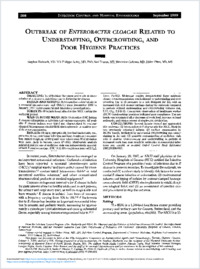
Outbreak of Enterobacter cloacae related to understaffing, overcrowding, and poor hygiene practices.
- Harbarth S Infection Control Program, University Hospitals of Geneva, Switzerland.
- Sudre P
- Dharan S
- Cadenas M
- Pittet D
- 1999-09-29
Published in:
- Infection control and hospital epidemiology. - 1999
Cross Infection
Crowding
Disease Outbreaks
Enterobacter cloacae
Enterobacteriaceae Infections
Equipment Contamination
Female
Gestational Age
Humans
Hygiene
Incidence
Infant, Newborn
Infection Control
Intensive Care Units, Neonatal
Logistic Models
Male
Personnel, Hospital
Retrospective Studies
Risk Factors
Switzerland
English
OBJECTIVE
To determine the cause and mode of transmission of a cluster of infections due to Enterobacter cloacae.
DESIGN AND SETTING
Retrospective cohort study in a neonatal intensive-care unit (NICU) from December 1996 to January 1997; environmental and laboratory investigations.
SUBJECTS
60 infants hospitalized in the NICU during the outbreak period.
MAIN OUTCOME MEASURES
Odds ratios (OR) linking E. cloacae colonization or infection and various exposures. All available E. cloacae isolates were typed and characterized by contour-clamped homogenous electric-field electrophoresis to confirm possible cross-transmission.
RESULTS
Of eight case-patients, two had bacteremia; one, pneumonia; one, soft-tissue infection; and four, respiratory colonization. Infants weighing <2,000 g and born before week 33 of gestation were more likely to become cases (P<.001). Multivariate analysis indicated that the use of multidose vials was independently associated with E. cloacae carriage (OR, 16.3; 95% confidence interval [CI95], 1.8-infinity; P=.011). Molecular studies demonstrated three epidemic clones. Cross-transmission was facilitated by understaffing and overcrowding (up to 25 neonates in a unit designed for 15), with an increased risk of E. cloacae carriage during the outbreak compared to periods without understaffing and overcrowding (relative risk, 5.97; CI95 2.2-16.4). Concurrent observation of healthcare worker (HCW) handwashing practices indicated poor compliance. The outbreak was terminated after decrease of work load, increase of hand antisepsis, and reinforcement of single-dose medication.
CONCLUSIONS
Several factors caused and aggravated this outbreak: (1) introduction of E. cloacae into the NICU, likely by two previously colonized infants; (2) further transmission by HCWs' hands, facilitated by substantial overcrowding and understaffing in the unit; (3) possible contamination of multidose vials with E. cloacae. Overcrowding and understaffing in periods of increased work load may result in outbreaks of nosocomial infections and should be avoided.
To determine the cause and mode of transmission of a cluster of infections due to Enterobacter cloacae.
DESIGN AND SETTING
Retrospective cohort study in a neonatal intensive-care unit (NICU) from December 1996 to January 1997; environmental and laboratory investigations.
SUBJECTS
60 infants hospitalized in the NICU during the outbreak period.
MAIN OUTCOME MEASURES
Odds ratios (OR) linking E. cloacae colonization or infection and various exposures. All available E. cloacae isolates were typed and characterized by contour-clamped homogenous electric-field electrophoresis to confirm possible cross-transmission.
RESULTS
Of eight case-patients, two had bacteremia; one, pneumonia; one, soft-tissue infection; and four, respiratory colonization. Infants weighing <2,000 g and born before week 33 of gestation were more likely to become cases (P<.001). Multivariate analysis indicated that the use of multidose vials was independently associated with E. cloacae carriage (OR, 16.3; 95% confidence interval [CI95], 1.8-infinity; P=.011). Molecular studies demonstrated three epidemic clones. Cross-transmission was facilitated by understaffing and overcrowding (up to 25 neonates in a unit designed for 15), with an increased risk of E. cloacae carriage during the outbreak compared to periods without understaffing and overcrowding (relative risk, 5.97; CI95 2.2-16.4). Concurrent observation of healthcare worker (HCW) handwashing practices indicated poor compliance. The outbreak was terminated after decrease of work load, increase of hand antisepsis, and reinforcement of single-dose medication.
CONCLUSIONS
Several factors caused and aggravated this outbreak: (1) introduction of E. cloacae into the NICU, likely by two previously colonized infants; (2) further transmission by HCWs' hands, facilitated by substantial overcrowding and understaffing in the unit; (3) possible contamination of multidose vials with E. cloacae. Overcrowding and understaffing in periods of increased work load may result in outbreaks of nosocomial infections and should be avoided.
- Language
-
- English
- Open access status
- green
- Identifiers
-
- DOI 10.1086/501677
- PMID 10501256
- Persistent URL
- https://sonar.rero.ch/global/documents/236739
Statistics
Document views: 33
File downloads:
- Full-text: 0